

Almoravid Koubba

Aerial view of the Almoravid Koubba

Almoravid Koubba

Loading available options...

Overview

  • Duration:4 hours 30 minutes
  • Travelers:5 guests
  • Tour Type:Culture & Landmark, Daily tour, Group tour, Private tour
  • Language:English
The Almoravid Koubba (also known as Koubba Ba'adiyin or Kouba Baroudiyine) is a small but historically monumental 12th-century domed pavilion located in the northern medina of Marrakesh, Morocco. Built between 1117 and 1120 under the direction of Sultan Ali ibn Yusuf, it stands as the oldest surviving building in Marrakesh. It is also the only completely intact structural remnant of the founding Almoravid dynasty left in the entire country. Originally serving as a key ritual ablution center for worshippers entering the long-destroyed initial Ben Youssef Mosque, the pavilion survived centuries of political replacement and heavy conflict simply by being buried. It was finally rediscovered in 1948 and completely excavated by archaeologists in 1952, revealing its sophisticated ancient architecture to the public.

Why You Should Visit

Visiting the Almoravid Koubba offers a unique, subterranean window into the physical roots of Moroccan-Andalusian architecture that set the decorative standards for nearly a millennium. Because centuries of urban construction gradually raised the street levels of the surrounding medina, you must descend two full flights of stairs into an open-air archaeological pit to enter the building, making it feel like a genuine hidden excavation site. The modest structure contains complex, foundational design elements—such as signature horseshoe arches, multi-layered ribbed domes, and geometric patterns—that were directly copied by later dynasties to build landmarks like the Koutoubia Mosque and Ben Youssef Madrasa.
Read more

Highlights

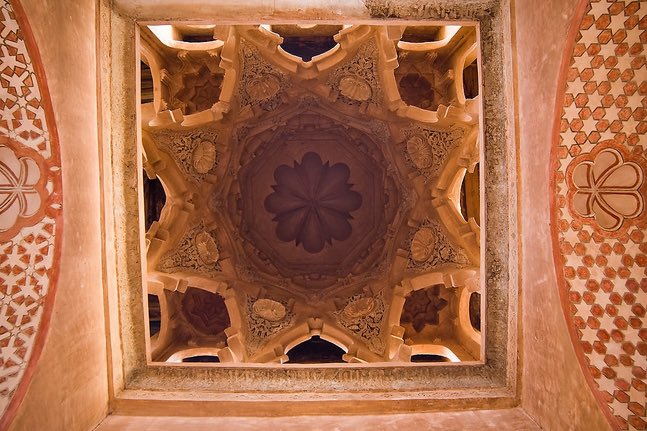
  • The Two-Tiered Ribbed Dome: A magnificent exterior dome design supported by a square foundation that transitions into a star-shaped octagon, setting the blueprint for later Islamic structures.
  • The Oldest Cursive Maghrebi Script: An ancient foundational text band engraved in the interior plaster that stands as the earliest recorded example of cursive Maghrebi calligraphy found in North Africa.
  • Advanced Hydraulic Channels: The exposed archaeological remains of an intricate underground piping network (khettaras) used to transport water from faraway aquifers to the heart of the city.
  • Early Arab-Andalusian Motifs: Well-preserved interior plaster carvings displaying the region's earliest known implementations of symbolic pine cones, palms, and acanthus leaf motifs.
  • Subterranean Cistern and Basins: A massive, deep underground water reservoir flanked by the historic remnants of three original public washing fountains and drinking taps.
  • Distinct Pre-Almohad Window Shapes: Beautifully cut, open arched window slots along the top tiers that later became the primary architectural symbol of subsequent Moroccan rulers.

Includes/Excludes

  • Shared tour
  • Hotel pickup and drop-off
  • Food

Cancellation policy

You can cancel up to 24 hours in advance of the experience for a full refund.

Frequently asked questions

What are the entrance fees and daily operating hours?

The archaeological monument welcomes visitors Monday through Friday from 8:30 AM to 6:00 PM, and remains closed on Saturdays and Sundays. A standard adult entry ticket costs 100 MAD (approximately $10 USD), while admission for children under the age of 12 costs 20 MAD.

Can I see the monument without purchasing an entry ticket?

Yes. Because the pavilion sits inside a deep, open-air excavated pit right next to the street plaza, the entire exterior profile and surrounding ruins can be viewed perfectly through the perimeter street railings without paying the door fee.

How much time does a standard visit require?

The site is quite small and compact. A full tour of the interior dome room and adjacent fountain basin typically takes only 30minutes to an hour.

What to bring

Moroccan Dirham (Cash)
Sturdy, Comfortable Footwear
Sun Protection
A Phone, Telephoto, or Zoom Lens
A Refillable Water Bottle
Sturdy Walking Shoes

You might also like...

Related Articles