



In Marrakech, beauty lives here. Beyond the organized chaos of the souks and squares, there is so much beauty in this old town that you just can’t help but stop and appreciate the wonder of its essence.
There is a different world to Marrakech behind its red clay walls and bustling Medina. Look closely, and you will find cobalt blue courtyards, olive groves a thousand years old, and a basin that reflects the Atlas Mountains at sunrise.
These are the beautiful gardens in Marrakech. They are so attractive and well-tended that you just can’t help but visit.
Jardin Majorelle: The Most Visited Garden in Marrakech
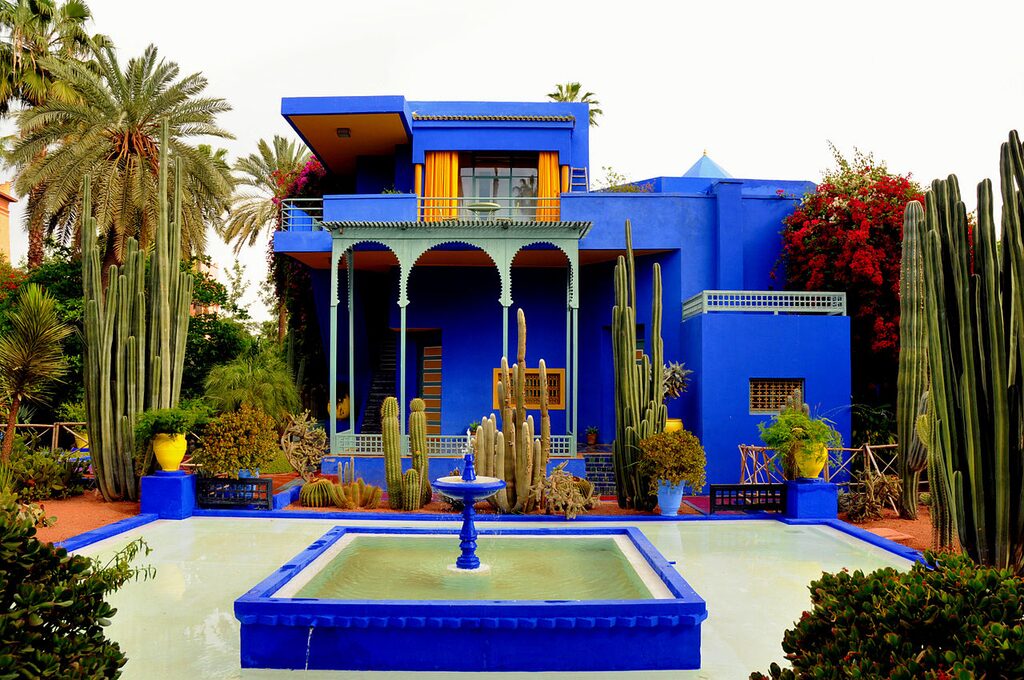
When Jacques Majorelle landed in Marrakech in 1917 to recover from illness, he never really left. In 1923, he bought a plot of land near Bab Doukkala, and for the next four decades, he shaped it into something the world had never quite seen: a 2.5-acre garden painted in a blue so electric it now carries his name.
Can we shock you? The Majorelle Blue isn’t a decoration. It’s a patented pigment, mixed by the artist himself in 1937, and it still coats the villa’s walls and fountains today.
Around it grow more than 300 plant species pulled from five continents: bamboo from Asia, cacti from Mexico, water lilies floating in stone basins, etc.

Majorelle called it his most beautiful work. He gave it, in his own words, all his love. Today, Jardin Majorelle (Majorelle Garden), located on Rue Yves Saint Laurent in the Guéliz neighborhood of Marrakech, Morocco, is the most visited garden in the Red City and one of its most patronized tourist attractions.
The access fee is 170 MAD for adults; international students/kids (over 10) pay 95 MAD; Moroccan residents pay lower local rates.
After his death in 1962, the garden was neglected. Then, in 1980, Yves Saint Laurent and his partner Pierre Bergé stepped in. They had discovered the place in 1966 and never forgot it. Saint Laurent later said its colors sharpened the boldness in his own designs. The pair bought the property before developers could turn it into a hotel, restored the irrigation, and expanded the plant collection.
Saint Laurent died in 2008. His ashes were scattered in the rose garden here, and two years later, the street outside was renamed Rue Yves Saint Laurent in his honor.
Today the site holds the Musée Pierre Bergé des Arts Berbères, the standalone Musée Yves Saint Laurent Marrakech, and Café Majorelle for a shaded break.
Book your ticket online. The queues are long for a reason, and they only grow longer by midday.
Le Jardin Secret

Location: 121 Rue Mouassine, Medina, Marrakech
Access Fee: 100 MAD (~€9.20) for adults. Tower Access: Additional 40 MAD (~€3.70). 80 MAD for young people (ages 12-24). Free for children under 12.
Le Jardin Secret is found inside the old Medina, where you can spend several minutes walking through tight lanes surrounded by shops, riads, and ancient walls. You can walk past the entrance of this garden without noticing it if you didn’t know to look.
Its story runs back to the 16th century, when the Saadian Sultan Moulay Abd-Allah developed the Mouassine district around a private palace. That palace crumbled after the Saadian dynasty fell, was rebuilt in the 19th century, changed hands more than once (one owner was poisoned with tea over a dispute), and eventually sat abandoned for decades.
Restoration began in 2008. The garden opened to the public in 2016, nearly 400 years after its conception.

Le Jardin Secret contains two distinct garden styles: an Islamic garden and an exotic garden. The Islamic garden uses geometry, water and planting to create a sense of order and calm.
Marrakech’s gardens have always depended on clever ways of moving water through dry environments. Le Jardin Secret was connected to the city’s old khettara system, a network of underground drainage galleries that brought groundwater towards the surface for use in gardens, fountains, hammams, and homes.
Le Jardin Secret has a tower that gives you a different view of the Medina and the surrounding city.
That tower is worth climbing.
Menara Gardens

Location: Avenue de la Menara, Marrakech, Morocco
Access Fee: Entry to the outdoor olive groves and grounds is completely free, while entering the historic Saadian pavilion costs around 10 to 70 MAD (roughly $1 to $7 USD).
Menara Gardens is one of the most beautiful gardens in Marrakech. The gardens are dominated by an enormous water basin, olive groves, and the famous pavilion with its green pyramidal roof.
The Atlas Mountains rise in the distance.
The origins of the Menara Gardens reach back to the Almohad period in the 12th century, under Caliph Abd al-Mu’min, who created it as both an orchard and a royal retreat.
The large reservoir formed part of a sophisticated system for managing water and irrigating the surrounding orchards.
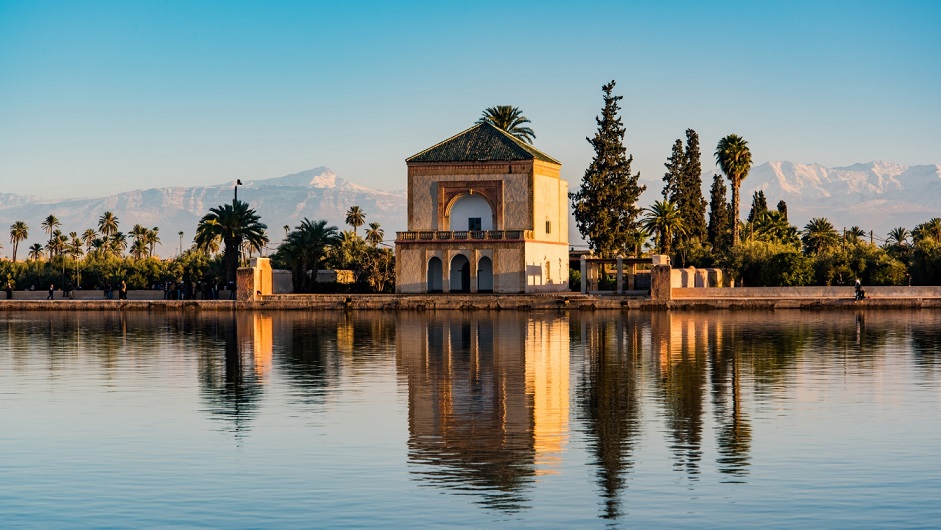
The composition is so photogenic, especially late in the afternoon.
The olive grove gives the place another feel. It’s a natural beauty everyone should experience.
If you’re travelling with a camera, give Menara time.
Menara, the Agdal Gardens, and the medina of Marrakech together earned UNESCO World Heritage status in 1985.
Agdal Gardens

Location: South of the Medina walls, accessible via Rue Sidi Mimoun or Route des Remparts.
Access Fee: Free to enter
The Agdal Gardens stretch across roughly 400 hectares of olive, citrus, pomegranate, and fig orchards, built in 1157 by the same Almohad caliph who commissioned Menara.
The name comes from the Berber word for a walled meadow. High earth ramparts enclose the entire estate, a private retreat built for the caliph and later maintained by the Saadian and Alaouite dynasties who followed him.
Water flows through a khettara network that stretches back to the Ourika Valley in the Atlas foothills, one of the oldest working irrigation systems still in use in Morocco.
At its center sits the Sahrij el-Hana, the Tank of Health, once used to train royal troops to swim.
There is a small island with a square pavilion in its middle, reachable only by boat in earlier centuries.
Agdal earned its UNESCO World Heritage listing in 1985 alongside Menara and the medina.
Check ahead before you go. Access sometimes closes without much notice when the royal family is in the residence.
You May Also Like:
10 Instagrammable Places in Marrakech You Should Never Miss
Top 8 Recreational Parks and Water Attractions in Marrakech
15 Must-Visit Cultural Landmarks and Historic Sites in Marrakech
Cyber Park Arsat Moulay Abdeslam

Location: Avenue Mohammed V / Boulevard Mohammed V, Marrakech, Morocco (situated between the Koutoubia Mosque and the Gueliz district)
Access Fee: Free to enter
Arsat Moulay Abdeslam is a historic garden in the heart of Marrakech, only a short distance from Jemaa el-Fnaa. The site covers about eight hectares and underwent a major rehabilitation in the early 2000s.
Sultan Sidi Mohammed Ben Abdellah commissioned the park in the 18th century as a wedding gift for his son, Prince Moulay Abdeslam. What began as an orchard for fruit and vegetables passed through French restructuring during the protectorate era, then fell into neglect until a full restoration brought it back.
The modern name comes from its free Wi-Fi access points, which is quite rare in public spaces across Marrakech. The eight-hectare park has turned into a beautiful meeting point for locals working, studying, or simply checking messages under the trees.
A small telecommunications museum is inside, and solar panels on site power thousands of light bulbs while cutting the park’s carbon footprint.
Walk the shaded alleys and you’ll pass roses, citrus trees, bougainvillea, and fountains, with turtles occasionally crossing the paths near the water features.
The cyber park garden is close to Jemaa el-Fna and the Koutoubia Mosque.
Anima Garden

Location: Ourika Valley (Route d’Ourika), 40000, Morocco
Access Fee: Adults (17+): MAD 140 (EUR 14). Children (Ages 12–16): MAD 60 (EUR 6). Children (Ages 0–11): Free (when accompanied by an adult)
Anima Garden was created by Austrian artist André Heller. His connection with Morocco began in 1972, when he first visited the country and ended up staying for four and a half months instead of the planned three weeks. Years later, he acquired eight hectares of fallow land south of Marrakech and spent six years turning it into the garden known as Anima.
The garden opened in 2016.
More than 250 types of plants grow here, alongside artworks by artists including Pablo Picasso and Keith Haring, as well as works by other artists and local talents.

The name Anima comes from Carl Jung’s term for the inner self, and Heller built the space around that idea: a place meant for wonder as much as botany.
Please note, Anima isn’t in the centre of Marrakech. It’s outside the city on the Ourika road, so you have to treat it as a proper excursion instead of an adventure to squeeze between two Medina stops.
Palmeraie Grove
Location: North of the city center / Medina of Marrakech, Morocco. About a 15- to 20-minute drive from the central Jemaa el-Fnaa square by taxi or rented car
Access Fee: Free to enter.
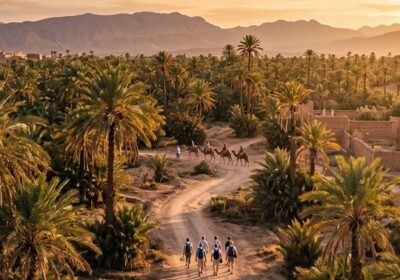
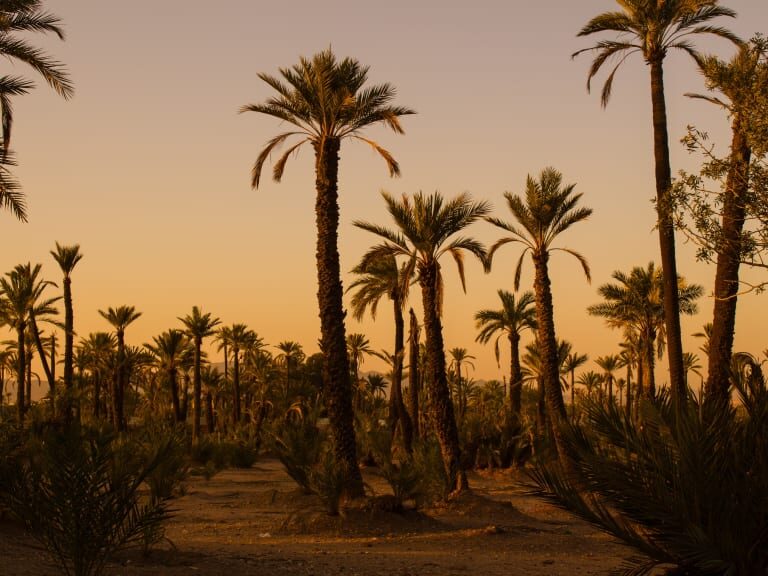
As the name implies, Palmeraie Grove is more than just a garden. It’s over a thousand years old, and stretches across thousands of hectares on the city’s edge.
The official Marrakech tourism guide describes La Palmeraie as a palm grove covering about 54 square miles, with hundreds of thousands of palm trees. Another official listing puts the cultivated area at around 13,000 hectares and estimates roughly 150,000 palm trees.
On getting there, you are instantly introduced to a world of tall date palms, dusty paths, low walls, villas, resorts, and pockets of cultivated land.

There are plenty of ways to experience Palmeraie Grove. You can cycle through parts of the palm grove or ride a camel. Horse-drawn carriage trips are also available, and quad biking is another popular activity.
Lodging in one of the luxury resorts in La Palmeraie is another awesome experience on its own.
For most tourists, the best time to experience the Palmeraie is when the sun begins to soften.
Jardin des Arts

Location: Marrakech 40000, Morocco
Access Fee: Free to enter. It is accessible 24 hours a day.
Jardin des Arts is one of the smaller gardens on this list. It’s essentially a garden and open-air art space rolled into one.
The site contains more than a dozen monumental sculptures by artists connected to Africa, with the works addressing subjects including climate, nature, materials and sustainable development.
Painter and sculptor Mahi Binebine created Jardin des Arts in 2016, timed to Marrakech’s hosting of the COP22 climate summit. He brought together 22 artists connected to the African continent, working with the BDA agency and the backing of the city’s mayor, and the garden opened just three months after the idea took shape.
Every piece here carries an environmental theme: sculptures built from recycled crates, plastic waste shaped into a maze, and works confronting climate change and sustainability.
Which of these beautiful gardens in Marrakech should you visit?
If you’ve got the time, visit all. However, if time is not on your side, choose according to the kind of experience you want.
For the most iconic garden: Jardin Majorelle.
For hidden beauty inside the Medina: Le Jardin Secret.
For Atlas Mountain views: Menara Gardens.
For royal history and huge open spaces: Agdal Gardens.
For a free urban garden break: Cyber Park Arsat Moulay Abdeslam.
For art and unusual botanical scenery: ANIMA Garden.
For palms, adventure, and an oasis atmosphere: Palmeraie.
For contemporary sculpture: Jardin des Arts.
Also Read:
25 Unusual Things to Do in Marrakech (A Tourist’s Pocket Guide)
25 Top Marrakech Hotels and Resorts Travelers Love
Top 12 Affordable Riads in Marrakech Under $100